


ECRIN 2030

Preparing European clinical research for the next decade.
The European clinical trial ecosystem is currently facing multiple challenges, mainly, but not limited to, the digital revolution, which requires adaptation and anticipation from organisations, including ECRIN. The ECRIN 2030 project will address, in three distinct pillars, three major challenges of clinical research over the next decade.
- Preparing the clinical research infrastructure for the European Health Data Space (Pillar 1)
- Developing services for the next generation of clinical trials (Pillar 2)
- Promoting ECRIN membership expansion alongside a mature and interconnected clinical trial infrastructure (Pillar 3)
The project in numbers:
The consortium
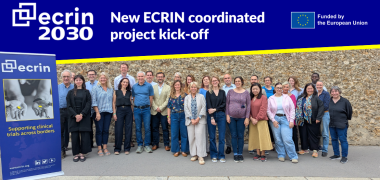
ECRIN 2030 brings together ECRIN and its national partner organisations from across Europe, each representing their country's clinical trial network.

The three pillars of ECRIN 2030
Pillar 1 - Anticipating the EHDS Regulation
Tools and services for the secondary use of health data and clinical trial data
Sharing clinical trial data after completion of the trial is a major component of transparent and FAIR research practice: providing the scientific community with access to individual patient-level clinical trial data enables re-analyses, secondary analyses, and/or meta-analyses. According to GDPR and its national interpretations, sharing participant data requires safeguards to protect privacy.
The European Health Data Space (EHDS) Regulation will provide a common framework for both primary and secondary use of health data in the European Union. The provisions for secondary use of electronic health records (EHRs) will have a major impact on both
the way individual patient-level clinical trial data will be shared (i.e. a secondary use of research data for research purposes)
the possibility to reuse data collected in the context of healthcare (i.e. using EHRs as eSource) to enrich the clinical trial case report forms (CRF) (i.e. a secondary use of health data for research purposes).
Pillar 1 will prepare ECRIN for EHDS implementation in 2029, capturing the national requirements for data sharing or secondary use, and establishing ECRIN as an Authorised Participant in the EHDS ecosystem, able to deliver Access Approvals. Based on this, ECRIN will develop a technical and regulatory capacity to offer services for clinical trial data sharing and for secondary use of electronic health records in clinical trials.
The first exercise in this Pillar is to capture the national requirements for data sharing and secondary use of EHRs: for investigators willing to share clinical trial data, for investigators inclined to access EHRs for secondary use in a multinational clinical study; conditions of GDPR compliance in each country; national implementation of opt out provisions; the conditions for the above in countries not covered by the EHDS, notably Switzerland, Canada and New Zealand.
The results of this mapping will be integrated into an open-access online tool, RED. Dedicated training for ECRIN staff and CTUs will be developed to address some of the key elements, such as data sharing and reuse, in the context of the EHDS.
Moreover, other ECRIN tools, the clinical research Data Sharing Repository (crDSR) and the clinical research MetaData Repository (crMDR), will be upgraded to adapt the data sharing procedure to ensure their compliance with the EHDS Regulation.
Ultimately, ECRIN will develop an EHDS-compliant clinical trial data sharing service, supporting both
the clinical trial data holders (i.e. sponsor and/or principal investigator) when preparing their data sharing plan (including specific informed consent if relevant), and after completion of the study (transferring the data to a data sharing SPE and establishing the contractual arrangement)
the clinical trial data re-users, supporting them in preparing the application to HDAB / authorised participant and, if accepted, in contractual arrangements and in processing the data within the SPE.
This Pillar will also upgrade the ECRIN data centre certification standards through an additional optional module, ensuring compliance of the ECRIN-certified data centre with the EHDS requirements for SPEs.
Pillar 2 - Towards a next generation of clinical trials
Making trials more patient-centric, inclusive, and greener
Clinical trials are increasingly using procedures conducted outside the traditional clinical trial site, leading to partly (hybrid) or fully decentralised trials. This is made possible through the increasing use of digital tools in clinical trials. By reducing barriers for patients and for investigation teams, decentralised trials are expected (at least under certain disease conditions) to reduce the burden of participation in trials.
In addition, a patient-centric decentralised model improves trial speed, quality, and inclusivity. This innovative approach leverages digital health technologies, such as telemedicine, sensory-based technologies, wearable medical devices, patient-driven virtual health care interfaces and remote methods, including the direct delivery of study drugs and materials to patients’ homes. As technology, infrastructure, and knowledge continue to advance, the inclusion of DCTs is becoming indispensable to the future of clinical research.
When planning a fully or partly decentralised trial, even more so when the trial involves multiple countries, investigators and sponsors need specialised support to consider country-specificities, while ensuring the quality of the data, efficiency of safety monitoring, the relevance of endpoints, and the regulatory and GCP-compliance of the study. They should additionally evaluate with patients and patient representatives the balance between the potential benefit of staying at home and the burden of the trial-related procedures, and take appropriate measures to reduce this burden.
Pillar 2 will therefore develop a series of generic (disease-agnostic) trial management services for multinational decentralised trials in Europe with the support of patients and patient experts.
The focus will be on the adaptation of ECRIN services to support the implementation of fully or partly decentralised trials. This requires a mapping of the European and national frameworks for the introduction of these decentralised elements. Building on which a plan to implement adapted and upgraded services, including both those coordinated centrally and those at the CTU level. This will be paired with dedicated training for ECRIN staff and CTUs.
Another issue to be addressed in ECRIN 2030 is the centralising of clinical trial data by converting remotely collected data into a single clinical trial data standard to feed the clinical trial eCRF. The principal being to deliver a robust, scalable framework for translating remotely collected multimodal patient data into interoperable clinical research standards (OMOP, CDISC), supporting real-time integration into clinical trial workflows and regulatory-grade data repositories.
To share information on national requirements with investigators and sponsors, ECRIN’s open access tool RED will be updated with the key information identified in the mapping.
Pillar 3 - Membership expansion and international cooperation
Growing ECRIN's footprint in Europe and beyond
ECRIN is a distributed infrastructure with currently 13 Member countries, covering more than 360M European citizens - the population size matters as it is proportionate to the patient recruitment capacity in clinical trials. However, many other parameters have to be taken into account: scientific excellence; maturity of the clinical trial ecosystem, including CTUs and investigation sites/networks; national registries; funding mechanisms; integration of clinical research into the health system; access to health data for clinical research; etc.
ECRIN Membership is currently focused on Europe. This makes sense because EU and associated countries share a common regulatory framework, and are eligible for multinational funding through the Horizon Europe programme. However, some investigators request support and trial management services outside of Europe. ECRIN has been involved in international activities since 2009, through participation in the OECD report on international cooperation in non-commercial clinical trials, followed by the OECD Council Recommendation on the Governance of Clinical Trials. ECRIN acted as the co-secretariat of the Clinical Research Initiative for Global Health (CRIGH, www.crigh.org). This international collaboration has led to cooperation agreements between ECRIN and specific countries (including Canada, USA, Brazil, Australia, New Zealand, Japan, Korea), resulting in an initial exchange of tools and best practices (eg. ECRIN has certified data centres in Japan, Korea, and New Zealand), but so farnot in operational services to international trial management. Following the COVID-19 outbreak, the World Health Assembly (WHA) adopted the 75.8 Resolution giving WHO the mandate to strengthen the clinical trials capacity and cooperation worldwide. ECRIN is a Member of the WHO-led Global Clinical Trial Forum (GCTF) and actively participates in the implementation of the WHO initiative.
Pillar 3 will develop a consistent strategy for ECRIN membership expansion based on a collection of the reasons for hesitancy in the non-member regions . It will also promote international cooperation, both with countries equipped with mature CTU networks (Canada, New-Zealand, Japan), and with less mature countries through capacity building and mentoring programmes aligned with the WHO strategy and the WHA 75.8 Resolution.
A structured interview will be prepared to capture the reasons for ECRIN Membership hesitancy in the Nordic, Baltic, Benelux and Balkan countries. Based on the in-depth analysis of the obstacles identified, strategic options for membership expansion will be discussed with ECRIN’s Boards.
Beyond Europe, Canada, New Zealand and Japan will be selected as pilot countries to develop and test procedures for joint support to international trials, as they are now eligible for Horizon Europe funding.
The WHO headquarters is preparing guidance documents to benchmark the maturity of the clinical trial ecosystems, and in particular of clinical trial units worldwide – and ECRIN is contributing to this exercise. However, establishing CTUs and national clinical trial ecosystems requires in-depth and practical discussions on the value, mission, objectives and priorities, considering the human resources, the competencies, the volume of activity, the economic and governance models. For this reason, meeting already established CTUs and networks will boost the development and maturation of clinical trial capacity. ECRIN will therefore, in agreement with the WHO headquarters, contribute to this initiative through: training webinars, short term mobility and mentoring programmes.
Project's activities
Discover the latest news about the project:
No deliverable available for the moment.

Co-funded by the European Union. Views and opinions expressed are however those of the author(s) only and do not necessarily reflect those of the European Union or European Research Executive Agency (REA). Neither the European Union nor the granting authority can be held responsible for them.